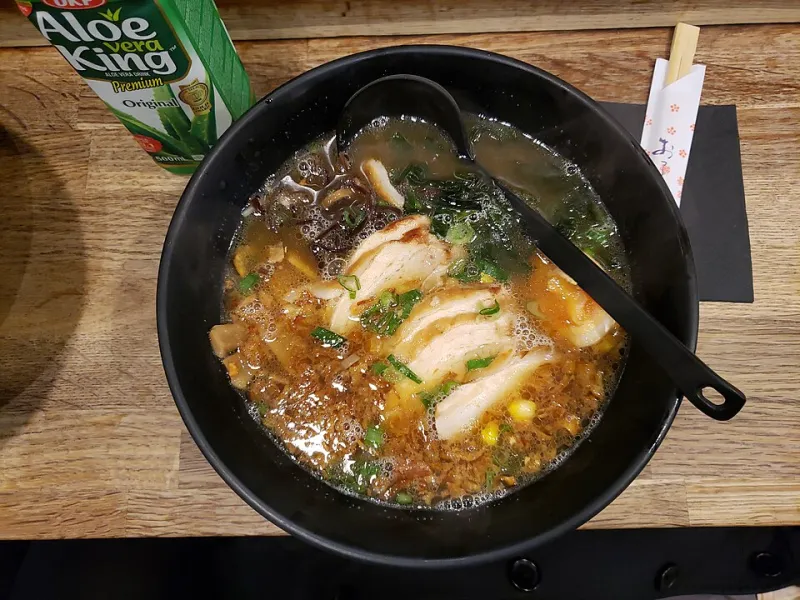
Reading the Bowl: What Clear, Cloudy, Creamy and Dark Broths Tell You

Photo: Giles Laurent, CC BY-SA 4.0, via Wikimedia Commons
Order enough bowls in North London and you start to notice that the liquid arrives in four broad moods. Clear and amber. Cloudy and pale. Creamy and opaque. Dark and almost black.
Those four looks are not decoration. They're a fairly reliable readout of how long the kitchen cooked, how hard it worked, and what it's trying to say. Here's how to decode them without turning into a bore about it.
The first rule: colour is a process, not a flavour
Broth colour comes from three things — how long bones simmer, how vigorously they simmer, and what gets stirred in at the end. A gentle simmer keeps the liquid clear because the proteins coagulate and get skimmed away. A rolling boil smashes fat and collagen into tiny droplets that stay suspended, which is why the bowl goes cloudy and eventually milky.
So when you see a clear bowl, you're looking at restraint. When you see an opaque one, you're looking at hours of hard boiling and a kitchen that has committed.
Clear: the quiet flex
Think pho bac from a northern Vietnamese kitchen, or a Tokyo-style shoyu ramen with a broth you can read a menu through.
Tasting notes: clean, saline, faintly sweet from chicken or beef bones, with a long savoury tail. In pho, the aromatics do the work — star anise, clove, cassia, charred ginger and onion. In a clear ramen, the tare (the seasoning base stirred into the bowl) supplies most of the personality.
What it tells you: the kitchen is confident. Clear broth is unforgiving. There's nowhere to hide a muddy flavour or a rushed skim, so a good clear bowl usually means someone is paying attention.
Order this if you find tonkotsu heavy, you like tea more than milkshakes, or you're eating at 2pm and want to be a functional person afterwards. Ask for a shio or shoyu ramen, or a northern-style pho.
Cloudy: the middle ground
Cloudy broth — sometimes called païtan in ramen terms — sits between the two extremes. Chicken bones boiled steadily rather than violently, or pork and chicken together, giving a broth that's opaque but not thick.
Tasting notes: roast chicken, a touch of sweetness, some body but no coating. On the palate it feels like a good stock rather than a sauce.
What it tells you: this is often the most technically interesting bowl on a menu, because the kitchen is balancing two things at once — flavour extraction and a clean-ish finish. It's also the family most likely to carry house twists: a bit of yuzu, a spoon of dried scallop, a smoked element.
Order this if you want something warming but not rich, or if you're the person at the table who always orders the thing in the middle of the menu. Tori païtan is your friend here.
Creamy: the full commitment
Opaque, pale, and thick enough to cling to the noodles. This is tonkotsu territory — pork bones boiled hard for twelve hours or more until the collagen dissolves into the liquid.
Tasting notes: deep pork, butter, sometimes a slightly funky edge. Texture is the headline: it coats the tongue and leaves a film on the lips. Good versions stay savoury; lazy ones taste like cream with salt in it.
What it tells you: a lot of gas, a lot of time, and usually a dedicated stock pot that never really stops. It also tells you the kitchen expects you to eat quickly — tonkotsu is at its best in the first ten minutes and starts to feel heavy afterwards.
Order this if you've had a cold, a long week, or a genuinely cold evening on the Regent's Canal. Don't order it before a meeting.
Dark: the loud one
Miso, black garlic, mayu (burnt garlic oil), or a heavy shoyu base. These bowls are dark brown to near-black and they smell like a Sunday roast gone rogue.
Tasting notes: toasted, savoury, sometimes sweet, often smoky. Miso brings fermented depth and a slight graininess. Black garlic brings an almost balsamic edge. Mayu adds a bitter, charred note that divides people cleanly into two camps.
What it tells you: this is the bowl the kitchen is showing off with. Dark broths are heavily seasoned by design, which means balance is harder — and a good one is a sign of a chef with a point of view rather than a recipe.
Order this if you like stout, Marmite, aged cheese, or the crispy bits at the edge of a roasting tin. Start with miso if you're new to the family; go black garlic once you trust the kitchen.
A short glossary, menu-reading only
- Chintan — clear broth, gently simmered and skimmed.
- Païtan — cloudy, opaque broth from a hard boil; usually chicken or a chicken-pork mix.
- Tonkotsu — pork bone broth, creamy and collagen-rich.
- Tare — the concentrated seasoning at the bottom of the bowl that the broth is poured over. Shio (salt), shoyu (soy), miso are all tare families.
- Mayu — burnt garlic oil, black and bitter.
- Ajitama — marinated soft-boiled egg. Not broth, but the best indicator of a kitchen's care.
- Pho bac / pho nam — northern (clearer, subtler) and southern (sweeter, more herbs) styles of Vietnamese pho.
- Nuoc cham — the sharp, sweet-sour dipping sauce served alongside.
- Hanh dam — pickled onions, the unsung hero of a good pho.
How to use any of this
Don't overthink it. The useful version is simply: clear means restraint, cloudy means balance, creamy means time, dark means opinion. If you liked a bowl, note which of those four words described it — that's a better guide to your next order than any star rating or topping list.
And if you're standing outside a noodle bar in Camden in November trying to decide, pick the one whose broth you can see through the window. The colour of the steam tells you nearly everything.