Broth, Bag and Bus: Putting Camden Takeaway Noodles Through the Walk-Home Test
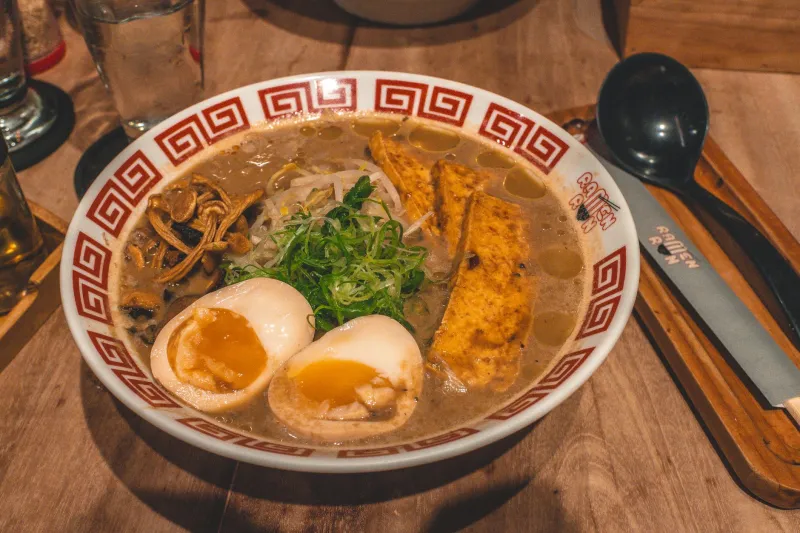
Photo: takeaway ramen broth in sealed container steam London street evening, via tb-static.uber.com
The walk home is the great unexamined part of the takeaway noodle experience. In Camden, that walk can be eight minutes to a flat off Delancey Street or twenty-five to a kitchen table in Kentish Town, and it can decide whether you sit down to a bowl with bite or a bowl of savoury porridge. So, on a wet Friday evening in October 2026, we did the obvious, slightly messy thing: ordered a shortlist of ramen, pho and late-night bowls from counters and delivery apps across NW1, then carried them home like small, leaking experiments.
This was not a lab test. There were no thermometers at first, then there were two, then one got dropped outside Mornington Crescent. But the pattern was clear enough: the bowl that travels best is rarely the bowl that looks most impressive at the counter. It is the bowl that has been packed with the journey in mind.
The rules of the walk-home window
We set a simple window: ten to twenty-five minutes from pickup to first slurp. That covers most of Camden, from the Market to Kentish Town Road, and it is roughly the time it takes for a hot broth to stop being hot and start being lukewarm. We tested six bowls: a Parkway tonkotsu, a Kentish Town Road pho, a vegetarian miso from a Market counter, a late-night shoyu near Mornington Crescent, a delivery-only laksa, and a bun bo hue from Chalk Farm.
Each was ordered twice where possible: once with noodles and broth packed together, once with them separated. We also noted packaging, leaks, reheatability and whether the garnishes survived. The results were not subtle.
Broth temperature: the first casualty
A sealed container of tonkotsu broth lost roughly eight to ten degrees Celsius on a fifteen-minute walk. A clearer shoyu broth lost more, because there is less fat and less body to hold the heat. Pho, ordered in a large tub, held its temperature better than expected, but only when the broth was packed separately from the noodles and herbs.
The worst result was a thin ramen broth packed with noodles already in it. By the time we got home, the broth had gone from steaming to tepid, and the noodles had drunk most of it. The bowl was not cold, exactly, but it had the dull, flat quality of something that had given up.
The lesson: fat and volume help, but separation helps more. If the broth is packed alone, you can bring it back to a hard simmer on the hob in two minutes. If it is already soaking into the noodles, you are just reheating a decision you cannot undo.
Noodles: the soggy truth
Fresh ramen noodles go stodgy fast. In broth, they were noticeably softer after seven to ten minutes, and by fifteen minutes they had lost the springy bite that makes ramen worth eating. Rice noodles for pho were more forgiving. They clumped, but a quick dip in hot broth loosened them, and they did not turn to paste in the same way.
Udon, which we did not include in the main test, has a similar advantage: thick and chewy, it can take a bit of travel. But the principle holds. If you want texture, ask for the noodles drained and packed separately. If the counter will not do that, choose a bowl with thicker noodles or a broth that is served less hot anyway.
The delivery-only laksa was a surprise. The noodles arrived separate, the broth was in a sealed tub, and the coconut milk had not split. It was not as good as eating in, but it was recognisably laksa. The bun bo hue, packed together, was a mess of soft noodles and lukewarm spice.
Leak watch: the bag is part of the bowl
We had two proper leaks. Both came from snap-lid containers that had been filled too full. One was a pho broth that seeped through the lid and into a paper bag; the other was a tonkotsu that left a greasy ring on a rucksack. The fix is boring but effective: ask for the broth in a sealed tub, then double-bag it. Carry it upright. Do not put it in a bike basket and hope.
Delivery apps are another matter. A courier who is balancing three orders is not going to keep your broth level. If you are ordering to a Camden flat, choose the option to meet at the door rather than leave it in a lobby. And if the app offers a 'broth separate' note, use it. It is not a guarantee, but it is a signal.
The verdict: what actually survives the walk
Best in show: tonkotsu with noodles and broth packed separately. The broth held its heat, the noodles kept their bite, and the chashu did not dissolve. Close second: pho with broth, noodles and herbs in separate containers. The broth needs a hard reheat, but the payoff is a bowl that still tastes fresh.
Most improved by good packaging: the delivery-only laksa. It had the advantage of being designed for travel, and it showed. Worst in test: thin shoyu ramen packed as a single unit. It was not awful, but it was not the bowl we ordered.
How to order for the walk home
Use short sentences at the counter. 'Broth separate, noodles drained, no extra broth, egg separate.' If the counter looks confused, explain that you are walking home and not eating in. Most places will do it. Ask for a double bag. Carry the broth flat and upright. Reheat on the hob, not in the microwave, and add any fresh herbs or spring onion at home.
The takeaway bowl is not a lesser bowl. It is a different dish with different rules. In a city where the walk home is often the best part of the night, it is worth ordering for the journey, not just for the counter.