Nine Quid or Eighteen? What a Camden Noodle Bowl's Price Is Actually Telling You
Photo: Basile Morin, CC BY-SA 4.0, via Wikimedia Commons
Put two noodle bowls in front of most people and they'll tell you which one they prefer. Put the receipts next to them and the conversation changes entirely.
On the same stretch of Camden — a few hundred metres, no meaningful difference in footfall — you can pay under a tenner for a bowl of ramen and comfortably over eighteen for another. Both are made by people who care. Both are, by any reasonable measure, worth eating. So what's the tenner doing?
We spent a few weeks asking. Owners, chefs, a couple of general managers, one very patient chap who does the ordering. Nobody wanted to be named, everyone wanted to talk, and the answers were remarkably consistent.
The two bowls
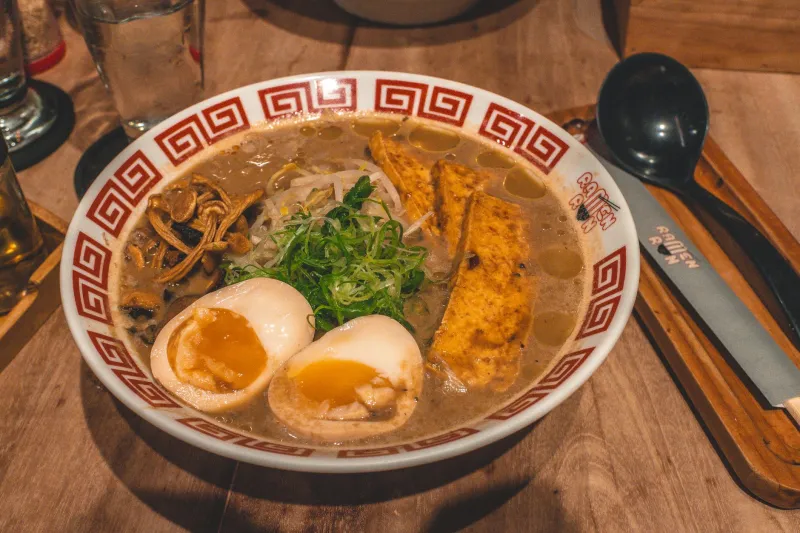
Bowl A: nine pounds something. Miso or shoyu, a soy-marinated egg if you're lucky, a couple of slices of chashu, spring onion, noodles from a supplier. Fifteen minutes from order to table. Paper menu, counter seating, one person front of house doing three jobs.
Bowl B: eighteen pounds, sometimes more. A broth that's been on since yesterday, a thicker cut of pork, a properly marinated egg, a garnish you can name. Twenty-five minutes, sometimes longer. Table service, a drinks list, a small kitchen brigade.
The nine-pound gap isn't one thing. It's six things, and they all interact.
Rent is the headline act
Ask anyone in Camden hospitality what's changed since they opened and the first word is almost always the same.
"The bowl hasn't got more expensive," one owner who's been on the same stretch of Parkway for the better part of a decade told us. "The square foot has."
Rough maths: on a bowl costing fourteen pounds, rent and rates can account for two to three pounds depending on the site — the premium end of Camden High Street, Hawley Wharf, the tourist-facing corners all push higher than the side streets. A counter operation squeezing twelve seats into a narrow unit spreads that differently to a sixty-cover room with a basement prep kitchen. The rent per bowl in a busy, tiny, high-turnover counter can actually be lower than in a spacious sit-down restaurant, because the counter sells the same square metre eleven times a day.
That's the first thing your price is telling you: how many times a day that address has to pay for itself.
Labour, the invisible ingredient
A bowl that costs nine pounds is usually a bowl that was made by someone doing more than one job. Order-taking, clearing, noodle-timing, washing up. That's not exploitation — it's a particular kind of small kitchen running on a particular kind of efficiency — but it does mean the wage bill is a smaller share of the total, because fewer people touch your bowl before you do.
On an eighteen-pound bowl, more people touch it. There's a prep cook who isn't also on the till. There's someone whose job is plating, which sounds indulgent until you've watched a hundred covers go out in ninety minutes and seen what happens when nobody's doing it.
Labour is also the cost that's moved most since 2024. Every operator we spoke to brought up wage inflation unprompted, and none of them brought it up as a complaint about staff. It was simply the line item that had grown the most, and the one least able to be shrunk without the food getting worse.
Bones, and the price of patience
Here's a thing people underestimate: a long broth doesn't just cost more in ingredients. It costs more in gas, in extraction, in fridge space, and in the risk that you've made too much and have to pour it away.
Pork bones and chicken carcasses aren't expensive per kilo. What's expensive is twelve hours of extraction on a commercial range and a walk-in that has to hold tomorrow's stock as well as today's. A shop doing one slow broth a day is running a different business to a shop doing four, and neither is wrong — they're just answering different questions about what they can sell before it turns.
Then there's the tonkotsu problem: you can't really rush it, you can't really hold it indefinitely, and you can't really serve it cheaply without either smaller portions or a queue that turns the whole thing into a volume game. Which brings us to the most Camden-specific cost of all.
The import line
In 2026, a lot of noodles are imported, and the price of a pallet of them moves for reasons that have nothing to do with Camden. Shipping, currency, the paperwork that didn't used to exist. Fresh noodles have a shelf life measured in days; dried ones don't but taste different; the frozen ones are excellent and eat your freezer space.
Every kitchen has picked a side. A nine-pound bowl is almost always working with a consistent, reliable, supplier-sourced noodle and building the interest elsewhere. An eighteen-pound bowl might be making noodles, or buying them in small fresh batches from a specialist, or both. Neither is a shortcut. They're just different answers to 'how do we keep this consistent at this price'.
The small stuff that adds up
Energy. Packaging. Card fees. Insurance. The bowls themselves — a proper ceramic bowl costs money and breaks, and takeaway containers cost money and don't come back.
A takeaway box, a bag, a set of disposable cutlery and a sticker can quietly account for the best part of a pound before the food is even in it. Some places absorb that. Some don't. If a takeaway bowl costs exactly the same as eating in, somebody has made a decision about which one they'd rather you did.
What the queue is telling you
A queue is a pricing signal, not just a popularity contest. If forty people are waiting for a nine-pound bowl, the kitchen is either extremely efficient or the price is slightly too low for the demand. Some places deliberately keep a queue long because a visible queue is the cheapest marketing in London. Others keep it short because a table turning three times an evening is worth more than a table turning twice at a higher margin.
When you see a bowl at eighteen pounds and no queue at seven on a Friday, that tells you something too. Sometimes it's a room built for a later crowd. Sometimes it's a room that's priced itself out of its own neighbourhood.
What the price doesn't tell you
It doesn't tell you which bowl tastes better. It doesn't tell you whether the cheap one is cutting a corner or just running lean. And it certainly doesn't tell you whether the expensive one is charging for quality or for a fit-out someone's still paying off.
What it does tell you, usually, is the shape of the operation: how many hands, how many hours, how much rent, how many turns. Two bowls ten pounds apart on the same street aren't rivals in the same market. They're two different businesses that happen to sell soup.
Which is why the most useful thing you can do in 2026 is stop asking whether a bowl is 'worth it' in the abstract and start asking what you're actually buying. A quick lunch. A slow evening. A seat. A story. A queue you stood in because everyone else did.
All of those are on the menu. None of them come free.