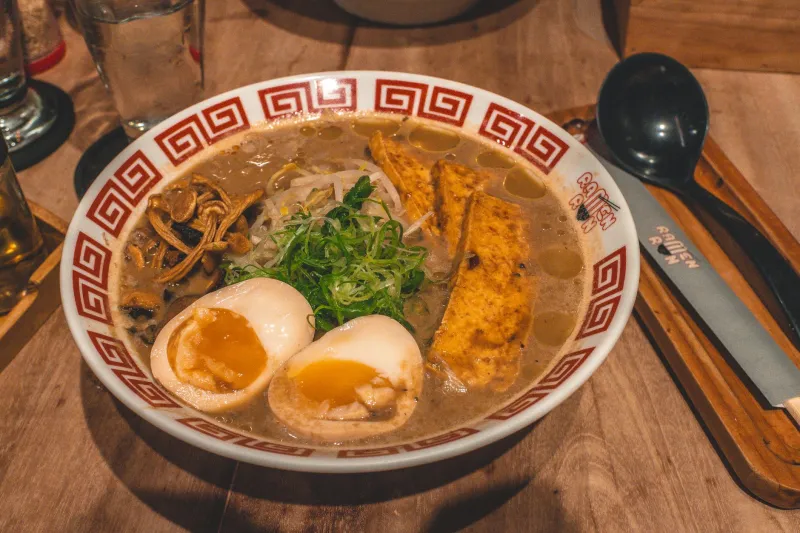
Six Bottles on the Table: How to Read Camden's Noodle Condiments

There is a moment, about ninety seconds after a bowl lands in front of you in Camden, when the condiment caddy starts calling. Six little bottles, a jar of something oily, a pot of pickled chillies, and a house chilli oil that looks like it means business. The temptation is to treat the lot like a dressing station. Resist it. A good noodle bowl is already a finished argument. Condiments are there to make a point, not to shout over the original speaker.
This is a field guide, not a rulebook. But after enough bowls in Kentish Town, Mornington Crescent and the bits of Camden where the steam fogs the windows, you start to notice patterns — and you start to read the caddy as a message from the kitchen.
First, taste the broth on its own
This sounds obvious. It is also the step most of us skip. Take one spoonful of broth before anything goes in. Then one mouthful of noodles. You are checking two things: how much salt is already there, and how much acidity the bowl has. A cloudy tonkotsu-style broth can take a lot of noise. A clear chicken or seafood broth often cannot. A pho broth that tastes flat at first is usually waiting for lime and chilli, not soy.
In Camden, where the noodle scene runs from market-stall fast to sit-down slow, this first taste matters even more. A bowl assembled in four minutes is often seasoned to be adjusted. A bowl that has simmered for eighteen hours is usually seasoned to be left alone.
Chilli oil: the loud one
Chilli oil is the first bottle everyone reaches for, and the one most likely to be misused. Good chilli oil is not just heat. It is aroma — toasted seeds, dried chillies, sometimes a bit of star anise or garlic — suspended in oil that carries flavour rather than just burn.
Add it when the broth tastes thin or one-note. A spoon of chilli oil can round out a porky broth or give a flat vegetarian bowl a bit of backbone. Hold back when the bowl is already rich, creamy or heavily spiced: you will lose the difference between the kitchen's chilli and the bottle's.
A useful test in a Kentish Town noodle bar: put a small dab on the edge of the spoon, not into the bowl. Taste it. If it is mostly heat with little fragrance, use less. If it smells like toasted chillies and sesame, it is probably house-made and worth a proper spoonful.
Black vinegar: the quiet fixer
If chilli oil is the loud one, black vinegar is the one that fixes things without announcing itself. A splash — and it really is a splash — can lift a heavy broth, cut through fatty pork, and make a bowl taste brighter without making it taste sour.
This is the bottle to reach for when a bowl feels muddy or claggy. It is also the one to leave alone if the broth is already delicate. In a clear chicken noodle or a lighter pho, black vinegar can trample the aromatics. In a rich, dark bowl, it is often the missing piece.
Watch how the kitchen treats it. A caddy with a good black vinegar — and a small spoon rather than a pourer — is usually a caddy from a kitchen that expects you to taste as you go.
Crispy garlic and pickled chillies: texture and lift
These two do different jobs. Crispy garlic is about texture as much as flavour: a little crunch against soft noodles, a savoury edge to a bowl that is all broth and no bite. Add it late, just before eating, or it goes soft and loses the point.
Pickled chillies are the opposite: sharp, acidic, and best used sparingly. One or two slices can wake up a bowl. A spoonful can turn it into a pickle sandwich. In Camden, where several counters leave a jar of pickled green chillies on the table, the smart move is to fish out a slice, taste it, and then decide. They are often hotter than they look and more acidic than you expect.
Sesame and soy: the background singers
Sesame — seeds, oil or paste — is there for aroma. A few drops of toasted sesame oil can make a bowl feel rounder and more finished. Too much and the whole thing tastes like the inside of a health-food shop. Add it at the end, off the heat, and use less than you think.
Soy is the salt adjustment. But it is also the easiest way to ruin a bowl that has already been seasoned properly. Before you reach for it, ask whether the broth actually needs salt or whether it needs acid, heat or texture. Nine times out of ten, it needs one of the latter. If you do add soy, add it to the spoon first, then the bowl. You cannot take it out.
What the caddy tells you about the kitchen
A condiment caddy is a small confession. A kitchen that leaves out a house chilli oil, a decent black vinegar and a jar of pickles is usually saying: we have seasoned this bowl, but we trust you to adjust the edges. A caddy with only soy sauce and a dusty chilli shaker is often saying: this bowl is what it is.
In Camden and Kentish Town, you can read a lot from the bottles. The market stalls tend to go heavy on chilli oil and pickled chillies — fast, punchy, built for a queue. The sit-down bars often put out fewer condiments, sometimes just a small dish of house chilli and a vinegar bottle, because the broth is the point. Neither is wrong. They are just different invitations.
A short field routine
Taste the broth. Taste the noodles. Decide what the bowl is missing, not what you usually add. If it needs heat, use chilli oil. If it needs brightness, use vinegar or pickled chilli. If it needs crunch, use crispy garlic. If it needs aroma, use sesame. If it needs salt, use soy — but only after you have checked the other four.
And if the bowl is already excellent, do nothing. That is allowed. In a city with this many noodle counters, the best condiment is sometimes a bit of restraint and a second spoonful of broth.