The Noodle Is the Dish: Who's Actually Making Their Own in Camden and Kentish Town
Broth gets the headlines. The noodle gets the bite. And in Camden and Kentish Town, the gap between a bowl that's made on site and one that's assembled from a wholesaler's box is wider than most menus let on.
Fresh, it turns out, is a slippery word. On a Camden menu it can mean three quite different things: dried noodles rehydrated in the kitchen, fresh noodles bought in from a supplier, or noodles mixed, rested, sheeted and cut in the building. Only the third is house-made, and it's rarer than the price tags suggest.
What 'fresh' actually means
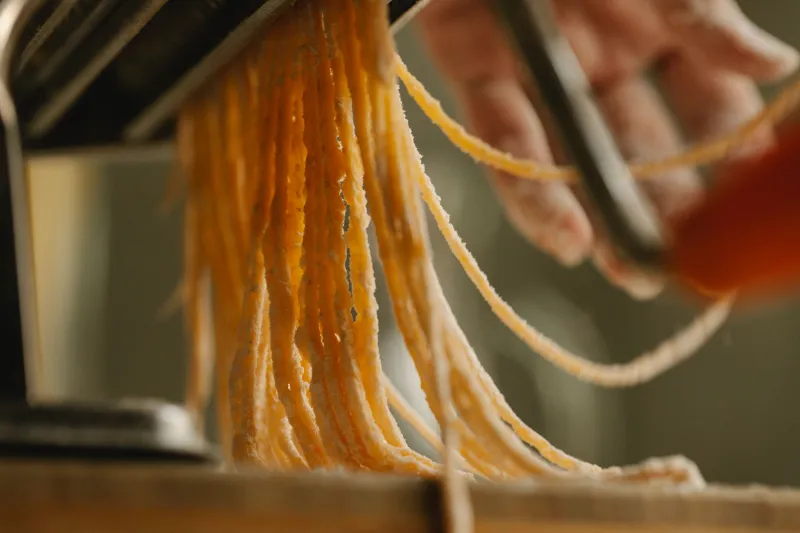
Dried ramen noodles are stable, cheap and consistent. They work for some styles — a light shoyu, a quick lunch — but they can taste of the packet and they tend to go soft fast. Fresh bought-in noodles arrive in vacuum packs, often part-cooked. They're springy and reliable, and plenty of good bowls use them. House-made noodles are a different animal: mixed on site, rested, rolled and cut, usually in small batches. They cost more in labour and space, and they behave differently in the bowl.
The chemistry, without the lecture
Ramen noodles are flour, water and alkaline salts — kansui, usually sodium carbonate and potassium carbonate. That's it. The alkaline salts do three jobs: they give the noodle its yellow tint, they make it springy rather than floppy, and they stop the surface turning starchy in hot broth, which is why a good noodle clings to the soup instead of sliding off it.
Hydration matters too. Ramen dough is dry by bread standards — often 30-40% water — which makes it stiff and hard to work. It needs a rest so the flour hydrates and the gluten relaxes. Then it's sheeted, which lines up the gluten and gives that characteristic bite, and cut to the width the kitchen wants. Some kitchens age the cut noodles for a day; the texture tightens and the flavour deepens. Skip the alkaline salts and you've basically made pasta. Nice, but not ramen.
Why more Camden kitchens don't do it
Space is the first answer. A noodle machine is a lump — a small one costs a few thousand pounds, a proper sheeter and cutter rather more — and it needs a room that stays cool and dry. Labour is the second: someone has to mix, rest, sheet, cut, wrap and clean, and that's before service. Consistency is the third. A house noodle changes with the weather and the flour; a bought-in one doesn't.
So most Camden and Kentish Town bars buy in, and there's no shame in it. The honest ones say so. The less honest ones lean on the word 'fresh' and let you assume the rest.
Five tells for spotting house-made
1. The menu language. 'Our noodles', 'made daily', 'kansui', 'aged' — these are signals. 'Fresh noodles' on its own is not; it usually just means they weren't dried.
2. Ask. 'Do you make your noodles here?' is a fair question and most staff will answer it straight. If they look shifty, that's an answer too.
3. The texture. House-made noodles often have a slightly irregular edge and a more pronounced alkaline smell. They resist the tooth, then give. Bought-in fresh noodles can be very uniform and a little slippery.
4. The broth cling. Pick up a strand. If the broth coats it and leaves a faint film, the surface is doing its job. If it drips off clean, the noodle is probably smoother and starchier.
5. The price. A pound or two more for house-made is normal. If a bowl is the same price as everyone else's and claims house-made noodles, ask again.
Where to look
The truth is that Camden's house-made noodle scene is small and quiet. The places worth asking are the independents — the Kentish Town counter with the machine by the pass, the Camden basement that mixes in the morning — and the nearby specialists.
Kanada-Ya in Angel is worth a visit; the group is open about its noodle recipe and the staff will tell you how it's made. Yokoya in Bloomsbury is the udon benchmark: made in-house, cut to order, and a reminder that house-made isn't only a ramen thing. If you're in Kentish Town, ask at the counter. The ones that do it are proud of it.
The verdict
House-made is a craft signal, not a guarantee. A bought-in noodle can be the right noodle for a delicate broth; a house-made one can be too chewy for a light shoyu. But in a city where broth has become theatre — 18-hour tonkotsu, three-day stocks — the noodle is the next frontier. Ask the question. The answer tells you more about the kitchen than the menu does.